Standards provide clarity and protect against a false sense of security
IEC 62305-compliant lightning protection is the benchmark for verifiable safety
A lightning event can endanger people, cause fires and disrupt connected technology in buildings.
Lightning strikes are a physical risk, and handling them goes beyond the mere installation of individual components. For decision-makers responsible for personnel, system and operational safety, the IEC 62305 international series of standards provides a clearly defined framework ranging from risk analysis to installation of external and internal lightning protection.
Find out how IEC 62305-compliant lightning protection can provide clarity for planning, installation, acceptance, auditing and operation.

Why standard-compliant lightning protection?
It is not the effort that counts, but the verifiable protective effect.
Effect instead of assumptions
Assess risks reliably
Verifiable safety
IEC lightning protection: a systematic approach, not isolated measures
IEC 62305 is not a collection of individual guidelines, but a systematically structured standard. Its strength lies in making lightning protection transparent, verifiable and documentable, from the planning stage right through to implementation.
This holistic approach is also reflected in the structure of the standard: The four parts of IEC 62305 form a coherent concept: from the physical principles to risk analysis through to the practical implementation of protection measures for structures and technical systems.

Part 1 – General principles
Physical principles and concepts as a common foundation.

Part 2 – Risk analysis
A systematic assessment of whether and to what extent lightning protection is required.

Part 3 – Protecting structures
Design and installation of external lightning protection (including the rolling sphere method and separation distances).

Part 4 – Protecting electrical and electronic systems
Internal lightning and surge protection to ensure full functionality.
Facts instead of preconceptions
Standard-compliant lightning protection is often considered to be complicated. This overview shows you why it is, in practice, the most reliable and cost-effective solution.
The risk analysis determines the requirements
Benefit:
Prevention of personal injury and fire and property damage through systematic planning.
The risk analysis in accordance with IEC 62305-2 objectively defines the required level of protection and uses this as the basis for deriving appropriate technical measures. Protection measures are designed to be cost-effective and tailored to the actual use of the system.
Geometrically verifiable protected volume
Benefit:
Lightning protection based on physics rather than theoretical assumptions.
The rolliing sphere method pursuant to IEC 62305‑3 makes the protected volume of air-termination systems geometrically visible and verifiable by calculation. Protection measures are justified and can be clearly documented in the audit or in the event of a claim.
International comparability
Benefit:
Planning and legal certainty across national borders and projects.
As an internationally harmonised standard, IEC 62305 sets out the application of acknowledged rules of technology and provides a robust basis for assessments by insurers and experts, and in the event of a claim.
Rolling spheres: from planning to protected volume
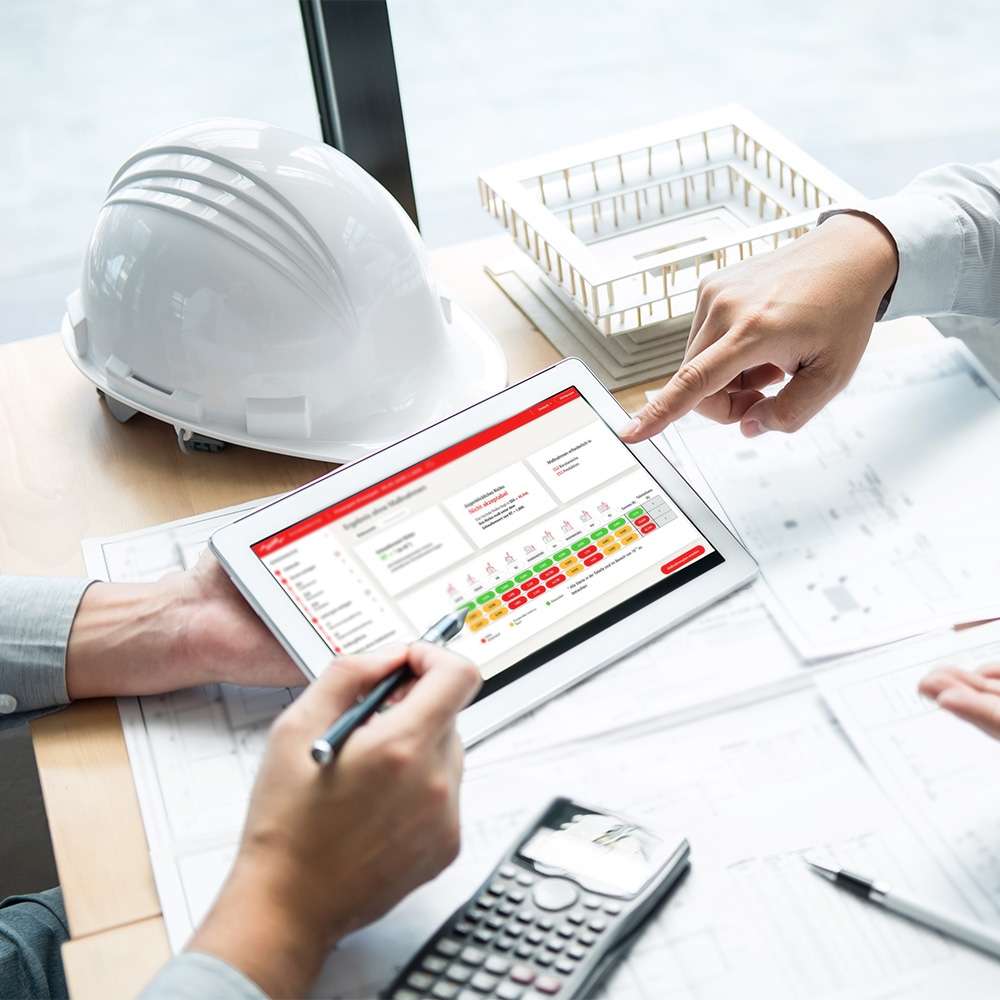
The benefits described are the result of a planning process defined in accordance with IEC 62305, where a risk analysis according to IEC 62305-2 is used to determine the required class of LPS. On this basis, the design and arrangement of the components of the lightning protection system are determined in accordance with IEC 62305-3.
The rolling sphere method demonstrates how the outer protected volume is specifically defined and tested in accordance with the relevant standards.
Rolling sphere method: definition of the protected volume
The rolling sphere method defines a building's external protected volume on the basis of a risk analysis. In this planning model, a virtual sphere is rolled over a model of a building. Wherever the sphere cannot come into contact with the structure due to the metal air-termination systems, a protected space is created. This approach makes the protected volume recognisable and transparent for everyone involved – so even in the design phase, it is clear whether the protection is effective and where adjustments are needed.


Lightning protection zone concept: tiered protection within the building
The lightning protection zone concept complements the external lightning protection system with a structured protection system inside the building. This specifically reduces the impact on sensitive equipment.
A comprehensive assessment of all transition points forms the basis for standard-compliant protection measures. Approaches without this zoning focus on individual sub-areas and fail to take into account the interactions within the system.
This is what defines the lightning protection zone concept:
The lightning protection zone concept protects electronic systems from lightning electromagnetic pulses (LEMPs), while external lightning protection primarily reduces the risk of fire.
Buildings are divided into lightning protection zones (LPZs) with defined exposure levels.
The definition is based on the number and sensitivity of the electronic devices to be protected.
At the zone boundaries, specially designed protective devices gradually reduce the incoming energy.
The external zones range from LPZ 0 A (direct lightning strike) to LPZ 0 B (no direct lightning strike, but full field exposure). In the inner zones, the exposure is gradually reduced by means of shielding and protective devices.


Standard-compliant lightning protection: proof, not assumption
When designing lightning protection systems, approaches differ in particular in terms of the standardised verification method used. IEC 62305-compliant methods are structured so that protected volumes can be described physically, checked during planning and documented. But it's not just the protected volume that is important: the standard also sets out specific requirements for air-termination systems, down conductors, earthing and equipotential bonding.
All of this makes it possible to clearly assess effectiveness – both in the design stage and during acceptance tests, audits or damage analyses. By contrast, approaches that lack a clearly defined framework for verification or testing can often only be verified or documented to a limited extent, which makes it difficult to assess their protective effect and residual risks.
Objections to IEC lightning protection – a technical assessment
The following table contrasts the frequently cited disadvantages of standard-compliant lightning protection according to IEC 62305 with their corresponding technical classification.
IEC-compliant lightning protection provides a solid foundation for safe, transparent and cost-effective decisions.
FAQs
The IEC 62305 series of standards sets out the principles for effective lightning protection. Among other things, this includes the protection of structures, installations, their contents and people. It harmonises safety standards at an international level, ensuring that technical requirements are kept up to date.
The IEC 62305 series of standards is divided into four parts. These cover general principles, risk management, the setup of a lightning protection system and guidelines for protecting electrical systems. This structure forms the reliable basis for the current third edition, covering all key areas of lightning protection.
No, the likelihood does not increase. As stated in the introduction to the standard, an external lightning protection system does not influence the fundamental strike mechanism between lightning and a building. The system does not increase or decrease the likelihood of a direct lightning strike.
The risk analysis is used to assess the risks of lightning damage. The procedure also helps in selecting technically and economically appropriate protective measures. However, the risk analysis does not exempt the user from complying with minimum building regulations or national requirements.
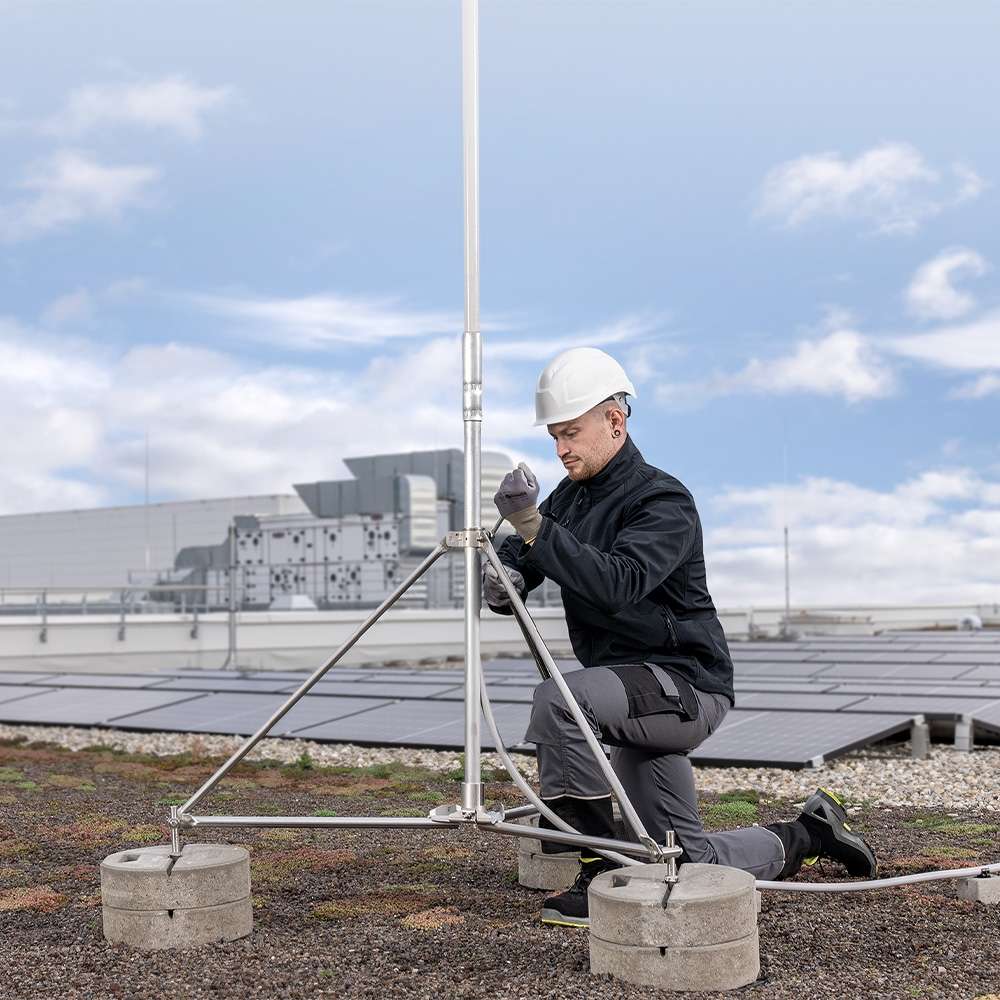
The third edition clearly stipulates that the rolling sphere method is the generally accepted method for designing air-termination systems. This method, in conjunction with software tools, allow the air-termination rods to be positioned with precision.
Electrically isolated lightning protection is based on high-voltage-insulated conductors that maintain an equivalent separation distance, preventing dangerous flashovers.
DEHN's HVI conductors direct the lightning current specifically to the earthing system without causing flashovers to other conductive components. HVI technology is used when it is not possible to maintain conventional separation distances.
In accordance with IEC 62561, components need to be tested to withstand lightning current loads without sustaining damage. Installers require official test reports or certificates to demonstrate that the components have been tested in accordance with the standard.
Yes – intrinsic components, such as metal pipes or PV mounting frames, may be used for lightning protection. However, the planning engineer or installer must explicitly assess the suitability of these components. Unsuitable components can cause dangerous overheating or mechanical damage in the event of a lightning strike.
